The Annual General Meet of IEEE Madras Section 2020 happened on 19th December, 2020, from 1.30PM to 5.00PM. IEEE Madras Section Chairman Dr. N. Kumarappan welcomed everyone and flipped through the activities and appreciated Student Branches, ExCom members, and professional members. Treasurer Dr. Joseph Gladwin briefed on the “Confirmation and Approval of Minutes of Annual General Meet happened on Aug 24, 2019”. He glanced through the “Receive and Adopt the Annual Audit Financial statement for the year 2020”, and then presented the appointment of Auditors for the year 2020-2021. As a new initiative, IEEE Madras Section granted “Section Rebate Award” to 43 active Student Branches. This was facilitated by Chair Dr. N. Kumarappan, Vice-Chair Dr. R. Ramarathnam, and Treasurer Dr. Joseph Gladwin. Later, professional members of IEEE Madras Section who have published their work in IEEE Journals were appreciated with a “Publication Award”. Finally, Treasurer Dr. Joseph Gladwin presented the vote of thanks and the gifts to the guests.
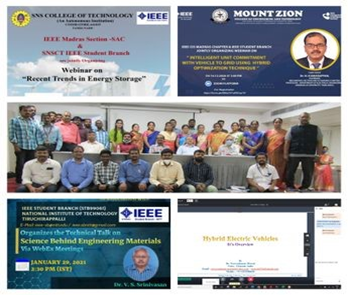
Webinar on “Hybrid Electrical Vehicle and its overview” IEEE Madras Section organized webinar on “Hybrid Electrical Vehicle and its Overview” on 12th December, 2020. The Speaker was Dr. Naveenkumar Marati, Senior Hardware Engineering R & D Valeo Chennai. Dr. M Venkatesh Kumar, Chair Professional Activities introduced the guest to the gathering. The webinar focused on electrical vehicle technology and operations. Around 30 participants participated.
Webinar on “Recent Trends in Energy Storage” SNS College of Technology, Coimbatore Photonics Society Student Branch Chapter and IEEE Madras Section – SAC organized a webinar on the “Recent Trends in Energy Storage” on 18th November, 2020. The resource person for the session was Dr. Ranjith Thangavel, Postdoctoral Researcher, Department of Energy Science, Sungkyunkwan University, Korea who shared his thoughts on the recent trends in energy storage. Around 58 participated in this event. This event was coordinated by Dr. K. Kalai Selvi, Dean – ECE, SNS College of Technology, Dr. N. Kumarappan, Chair, SAC & Chairman, IEEE Madras Section, and Mr. M. Saravanan, IEEE Student Branch Counsellor.
Webinar on “Intelligence Unit Commitment with Vehicle to Grid using Hybrid Optimization Technique” The IEEE CIS Madras Chapter & IEEE Student Branch of Mount Zion College of Engineering and Technology organized a Webinar on “Intelligence unit commitment with the vehicle to grid using hybrid optimization technique” on 16th December, 2020. Mr. K. Ramachandran, IEEE Student Branch Coordinator introduced the guest speaker Dr. N. Kumarappan, Chairman, IEEE Madras Section and CIS Madras Chapter and Professor, Department of Electrical Engineering, Annamalai University, Tamil Nadu. He shared some valuable information about intelligence unit’s commitment on the vehicle to grid using a hybrid optimization technique. Around 80 students attended the event.
Technical Talk on “Science behind Engineering Materials” The IEEE Student Branch of NIT-Tiruchirappalli and IEEE Madras Section organized a technical talk titled “Science Behind Engineering Materials” on 29th January, 2021 by Dr. V. S. Srinivasan, Professor, Homi Bhabha National Institute and Head, LIMS, IGCAR, Kalpakkam. Dr. Kumarappan introduced the speaker whi proceeded to discuss about some fundamentals of crystals and microstructure, mechanical testing, fatigue and creep of materials, modeling and simulation, and the material used for thermal nuclear reactors.
IEEE KOLKATA SECTION
Recent Activities of Kolkata Section
Tridibesh Nag, Newsletter Chair for IEEE Kolkata Section
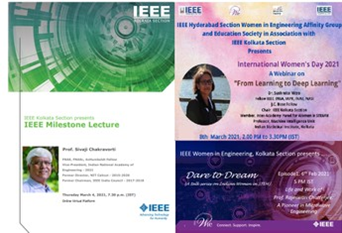
IEEE Women in Engineering Kolkata Section has started “Dare to Dream”, a talk series on Indian Women who had ventured into STEM careers more than 50 years ago. The inaugural episode of the series was held on 6th February, 2021. The talk “Life and Work of Prof. Rajeswari Chatterjee: A Pioneer in Microwave Engineering” based on the research by Ms. Ishani Hazra, was delivered by Prof. Prasanta Kumar Basu. The late Prof. Rajeswari Chatterjee (1922-2010) was the first woman scientist to pioneer in the field of microwave engineering in India. The talk chronicled her scientific and engineering career journey overcoming multiple adversaries of the pre-independence India and the outbreak of World War II. The talk also focused on her PhD and training in the US and her return to independent India to join IISc Bangalore as a faculty. Her inspirational story of path breaking research in microwave thereby producing numerous illustrious students who shaped India, motivated the audience. Total number of participants for the event is 120.
IEEE Milestone Lecture IEEE Kolkata Section organized an IEEE Milestone Lecture on 4th March, 2021 at 7:30 PM (IST) through online virtual platform. The talk was delivered by Prof. Sivaji Chakravarty, FNAE, FNASc, AvHumboldt Fellow Vice-President, Indian National Academy of Engineering – 2021, Professor Jadavpur University, Kolkata, India. The talk was on the first two IEEE Milestones in India dedicated in 2012 by the then IEEE President-Elect Dr. Peter Staecker. In this talk details of the IEEE Program were presented starting from its inception. A major point of discussion was the criteria for obtaining approval of an IEEE Milestone and the process of approval. Historic significance of the first two milestones in India was beautifully outlined along with its technicalities. Information about the dedication programs held in 2012 was given along with the press clippings. Finally, the IEEE Milestone Map and the present status of the other IEEE Milestones in India was elaborated. Such an informative lecture was extremely enlightening for the participants. The program was live on the Kolkata Section YouTube channel and attracted a total of 46 participants.
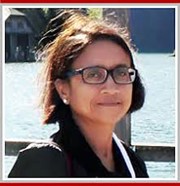
Webinar on International Women’s Day titled “FROM LEARNING TO DEEP LEARNING”. To intrigue interest in the domain of AI, machine learning and Deep Learning, IEEE Hyderabad Section Women in Engineering Affinity Group (WIE AG) and Education Society in association with IEEE Kolkata Section Recent Activities of Kolkata Section Tridibesh Nag, Newsletter Chair for IEEE Kolkata Section IEEE Kolkata Section organized a webinar on the occasion of International Women’s Day titled “From Learning to Deep Learning” by Dr. Sushmita Mitra, Fellow IEEE, INSA, IAPR, INAE, NASI, J.C. Bose Fellow, Chair, IEEE Kolkata Section, Member, Inter- Academy Panel for Women in STEMM, Professor, Machine Intelligence Unit, Indian Statistical Institute, Kolkata, on 8th March, 2021 from 2.00P.M to 3.30P.M IST through WebEx. The lecture was beneficial for the participants and attracted a total of 85 participants.
IEEE KERALA SECTION
Accolades Amidst a Pandemic
Gilesh M P, Secretary for IEEE Kerala Section
On 30th January, 2021, IEEE Kerala Section held its Annual Awards Ceremony for the year 2020. The edition of the most prestigious award instituted by the Section in memory of its founder chair and the doyen of electronic Industry, Padma Bhushan Shri. K. P. P. Nambiar was bestowed upon Dr. M. S. Valiathan for his distinguished contributions in the field of medical technology in India. Instituted in the year 2017, the K. P. P. Nambiar Award honors an individual or institution in the State for significant contributions to the IEEE vision of “Advancing Technology for Humanity” through research, development and application of technology that benefits humanity, devoid of social bias. The awardee Dr. M. S. Valiathan, a renowned Cardiac Surgeon and the Founder-Director of Sree Chitra Tirunal Institute of Medical Sciences and Technology (SCTIMST), was honored for his exemplary role in the creation and propagation of biomedical technologies in the country.
The event was conducted in a composite structure with small group gathering physically at Trivandrum, Kochi, and Kozhikode adhering to the COVID-19 protocols, connecting over Zoom, and live streaming on the IEEE Kerala Section YouTube Channel. For the first time ever a Section event was streamed over IEEE TV, the official channel of IEEE HQ. The award ceremony recognized eminent personalities and organizations in the field of Science & Technology with honorable positions.
Outstanding Women Engineer Award – Ms. Rameetha K, Scientist ‘G’, NPOL, Kochi;
Outstanding Industry Contributions Award – Mr. C. Balagopal, Founder-CEO of Terumo Penpol;
Friend of IEEE Awards – Mr. Prasad B. Nair (CEO, Maker Village); Dr KN Madhusoodanan (CUSAT); and Dr. P. S. Sathi Devi (NIT Calicut);
Outstanding Teacher Award – Dr. Bijuna Kunju (TKMCE) and Dr.Dhanaraj K. J. (NIT Calicut);
Outstanding Researcher Award – Dr. B. S. Manoj (IIST); and
Outstanding Start-up Award – GenRobotics Innovations Pvt. Ltd.
IEEE Kerala Section presented several professional members with Professional Awards, including Mr.Shankar Jayaraj (Outstanding Volunteer); Ms. Jiby Krishna K. G. (Outstanding WiE Volunteer); Mr. Rejin Narayanan (Outstanding Humanitarian Volunteer); Varghese Cherian (Outstanding Industry Contributions); Ms. Juliana Biju (Outstanding YP Volunteer); Mr. Akash Nambiar (Outstanding YP Volunteer); Mr. Midhun C. (Notable Technical Contributions) and Mr. Albin Paul (Outstanding Humanitarian Volunteer – Special Mention). Extraordinary performance by student volunteers was acknowledged by the Student Awards along with a special mention on institutions that provided support to IEEE student activities including Rajagiri School of Engineering and Technology (RSET) – Ernakulam; Sree Chitra Thirunal College of Engineering (SCTCE) – Trivandrum; and Jawaharlal College of Engineering and Technology, Lakkidi.
Being a global organization that works towards enhancing technology and making it accessible to every sector of society, IEEE observes its members and their contributions with utmost regard, making this award function a stimulus for a better tomorrow.
IEEE INDONESIA SECTION
IEEE Indonesia Section and Directorate General of Higher Education Discuss the Possibility of Program Synchronization
Gamantyo Hendrantoro, Vice Chair for IEEE Indonesia Section
The IEEE Indonesia Section held an online meeting with the Directorate General of Higher Education, Ministry of Education and Culture of the Republic of Indonesia on Tuesday, 2nd February, 2021. The meeting discussed the potential for synchronizing IEEE Indonesia Section programs with those of the Directorate General of Higher Education. The meeting was attended by the IEEE Indonesia Section 2021 Chair, Dr. Ing. Wahyudi Hasbi, and Vice Chair, Prof. Gamantyo Hendrantoro, as well as the Director General of Higher Education, Prof. Nizam and the Secretary of the Directorate General, Dr. Paristiyanti Nurwardani. Members of the IEEE Indonesia Section Activity Committee and the Technical Society Chapters of IEEE Indonesia Section were also present.
In his presentation, the IEEE Indonesia Section 2021 Chair conveyed several programs that could improve the quality of learning, the lecturers and the students. One program aims to improve the quality of conferences held by universities, while another involves making the IEEE journals, conferences and the IEEEXplore as an outlet for high-quality research from Indonesian universities. In addition to that, the Distinguished Lecturer Program offered by many IEEE Societies can be used to trigger research collaborations with Indonesian researchers.
“There are also other programs such as the IEEE Indonesia Initiative on Data Science and Artificial Intelligence and international competitions for IEEE Student Members, such as IEEEXtreme targeting at improving students’ coding skills, team work etc. The synergy between the IEEE Indonesia Section and the Higher Education Directorate will allow development of technology standards in Indonesia, assessment of the effectiveness and efficiency of the implementation of online lectures by experts from the IEEE Education Technology Chapter, establishment of an East Indonesia IEEE Conference Flagship, and execution of an IEEE Indonesian Student Conference together with the National Student Scientific Week held yearly by the Directorate General,” Wahyudi said.
On the same occasion, the IEEE Indonesia Section 2021 Vice Chair described the possibilities of collaboration in facilitating the implementation of the Ministry’s “Free to Learn – Free Campus”, locally known as the Merdeka Belajar-Kampus Merdeka or MBKM program. The possibilities include students’ participation in the humanitarian projects organized by the Special Interest Group on Humanitarian Technology (SIGHT) and Humanitarian Technology, as well as early experience for students with international professional organizations through involvement in IEEE Student Branches. In addition, IEEE Indonesia Section can serve as a bridge for research collaboration between universities and research institutions and for students’ free-to-learn activities in the industry, research organizations, etc.. “The activities can take the form of humanitarian projects, internships, research, start-ups and others,” said Gamantyo.
The potential for synchronization was welcomed by the Director General of Higher Education, Prof. Nizam. According to him, the IEEE Indonesia Section can be a means of implementing the MBKM program. He hopes that engineering students in Indonesia can join as members of the IEEE Indonesia Section. IEEE is also expected to help improve the quality of Indonesian journals so that they achieve an international reputation. This meeting will be followed up with an agreement and working plan.
IEEE INDIA COUNCIL
Erase the Boundaries
Utkarsh Singh, Editor-Newsletter for IEEE India Council
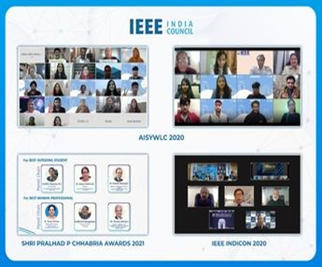
All India Students, Young Professionals, Women in Engineering, Life Members Congress (AISYWLC) was organized by IEEE India Council & IEEE Delhi Section at Chitkara University from 18th to 27th December, 2020 virtually. The event, themed “Erase The Boundaries”, was attended by more than 700 delegates. Guest speakers were Dr. Aloknath De (CTO, Samsung India), Dr. Gulshan Rai, (First Chief of Cyber Security – PMO, India), etc. India Council also conducted INDICON 2020 from 11th to 13th December, 2020. Prof. Toshio Fukuda, Dr. Lance Fung, Dr. Suresh Nair, Mr. Deepak Mathur, and around 500 researchers contributed to this event.
India Council inaugurated Prahlad P Chhabria Awards in memory of Late Shri Pralhad P Chhabria, Founder-Chairman, Finolex Group of Companies. Sponsored by HOPE Foundation and Research Centre with total prizes worth INR350,000, this award is conferred on young women for achievements in an undergraduate college or professional arena. The winner announcements were held in a virtual mode on 12th March, 2021. IEEE India Council also partnered with IEEE Nagpur Subsection in hosting the WIE International Leadership Summit (ILS) with 500 participants on 6th November, 2020. The summit was inaugurated at the hands of Akinori Nishihara, Director of Region 10 & Deepak Mathur, Director-Elect of Region 10. Whereas Dr. Suresh Nair, IEEE India Council Chair-Elect & Dr. Lance Fung, 2021-2022 R10 Director-Elect graced the valedictory function.
IEEE HYDERABAD SECTION
IEEE Hyderabad Section Annual General Body Meeting (AGM 2021)
Mohammed Arifuddin Sohel, Secretary for IEEE Hyderabad Section
The IEEE Hyderabad Section, India organized its Annual General Body Meeting (AGM – 2021) on 24th January, 2021, from 10.00AM to 2.30PM at Hotel Taj Vivanta, Begumpet in hybrid mode. The AGM started with a welcome address by Amit Kumar, Chair who appreciated the volunteers’ efforts in organizing over 1400 virtual and hybrid events. Bala Peddigari, the Secretary, briefed that the IEEE membership of Hyderabad Section was 4066 at the end of 2020 and highlighted two special efforts of the Section in organizing the IEEE Hydcon 2020 and in mobilizing the IEEE COVID MOVE initiative. Dr. MGPL Narayana, past chair, IEEE Hyderabad Section paid Tribute to Shri. F.C. Kohli.
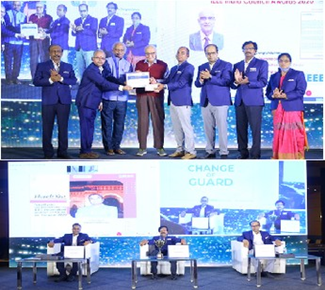
A computer society flagship event, the F.C. Kohli memorial lecture was held on 19th March of every year to mark the birth anniversary of Shri. F.C. Kohli. The chief guest of the function Dr. Deepak Mathur, Director, Region 10 joined through WebEx mode and appreciated the efforts of Section volunteers for their dedicated efforts to further the cause of IEEE. The awards ceremony was conducted to facilitate the active volunteers of the Section. IEEE Hyderabad Section was privileged to honor BL Deekshatalu with India Council Life Time Achievement Award. N Venkatesh, Nominations Committee Chair introduced the full slate of IEEE Hyderabad Section for the year 2021 and initiated the Change of Guard.
Srinivas Jasti takes over as the Chairman, R. Balasubmanian as the Vice Chair, Mohammed Arifuddin Sohel as the Secretary and Bala Prasad Peddigari as the Treasurer. The outgoing chairs and volunteers were awarded with digital certificates. Sreenivas Jasti, incumbent chair, shared his vision for the year 2021 and encouraged the volunteers to refer to IEEE Future Directions Initiatives for new technology areas and engage with IEEE Foundation to drive initiatives aligned to the theme ILLUMINATE EDUCATE ENGAGE ENERGISE. The vote of thanks was presented by Bala Peddigari. Posters of chapter activities were displayed before and after the main sessions of AGM. The participants were treated to a tasty ethnic cuisine during lunch and safety norms laid out by the local government were strictly followed throughout the event. The event was attended by 171 IEEE members.
IEEE GUJARAT SECTION
Technical Talk on How do Self-Driving Vehicles work”
Chirag Paunwala, Secretary for IEEE Gujarat Section
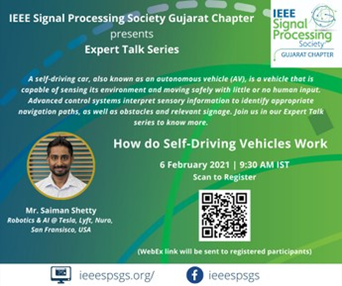
IEEE Signal Processing Society Chapter, Gujarat Section has initiated a Technical Talk Series intending to bring eminent experts in the field of Signal Processing, Machine/Deep learning, and Wireless Communications to provide a platform for budding engineers and professionals to benefit from the experts. The talk was on 6th February, 2021 with the title “How do Self-Driving Vehicles work” by Mr. Saiman Shetty, Robotics & AI Engineer, Tesla, Lyft, Nuro, San Fansisco, USA. He gave highlights on advanced control system and interpretation of sensory information to identify appropriate navigation paths as well as obstacles and relevant signage. Approximately 400 registered participants attended the event. The upcoming expert talks are on (1) “Transfer learning for Image and Video Recognition” by Dr. Dong Xu, IEEE SPS Distinguished Lecturer, and (2) “Sensing and Signal Processing for Autonomous Navigation” by Dr. K V S Hari, Professor, IISc, Bangalore.
IEEE BAHAWALPUR SUBSECTION
First Annual General Meetup of Bahawalpur Subsection
Dr. Khan Bahadar Khattak, General Secretary for Bahawalpur Subsection
IEEE Bahawalpur Subsection was established on 13th February, 2016 and is one of the three Subsections of Pakistan. It is under the Lahore Section and is one of the most active Subsections of IEEE Region 10. During the last 5 years, the IEEE Bahawalpur Subsection conducted multiple events and seminars. The major events include Student/YP/WIE congresses, Asia/Pacific ComSoc Summer School Program and the IEEE International Multi-topic conference. After conducting these successful events, we started our preparations for the First Annual General Meetup of Bahawalpur Subsection.
All the five Student Branches, namely, IEEE UCET – the Islamia University of Bahawalpur Student Branch, IEEE UCET– the Bahauddin Zakriya University of Multan Student Branch, IEEE Khawaja Farid University of Engineering and Information Technology Rahim Yar Khan Student Branch, IEEE National Fertilizer Corporation Institute of Engineering and Technology Multan Student Branch, and IEEE Muhammad Nawaz Sharif University of Agriculture Multan Student Branch, were taken on board for this meeting. A call was open for all the Student Branches to submit their yearly report in a form of recorded presentations as due to the COVID-19 SOPs the AGM was supposed to be a small gathering.
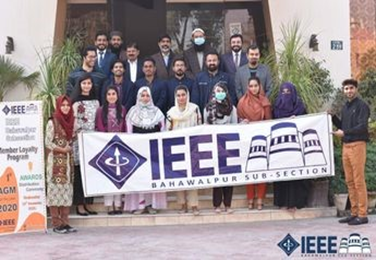
IEEE Bahawalpur Subsection organized its first annual general meeting on 24th December, 2020. Dr. Muhammad Ali Qureshi led this event as the Chairperson for IEEE Bahawalpur Subsection. Representatives of all the Student Branches and Student Chapters were called to present their performance for the previous year and targeted plans for the tenure of 2021. Moreover, the IEEE Bahawalpur Subsection launched the Member Loyalty Program to recognize its loyal members for their association based on the years of membership. This program aims to recognize the members of IEEE Bahawalpur Subsection for three and five years of service as an IEEE member associated with the IEEE Bahawalpur Subsection. The duration calculations were based on the cumulative years of service regardless of grade. Moreover, sponsorships of IEEE memberships for the members of IEEE Bahawalpur Subsection were announced. The motivation of the loyalty program is to develop the IEEE memberships for coming years. Also, it will engage more technical community within the IEEE network.
Prof. Dr. Muhammad Amjad and Dr. Muhammad Ali Qureshi presented the shields of recognitions to the nominated members. At the end of the event, official logo of IEEE Bahawalpur Subsection was inaugurated and award of appreciation was presented to the logo designer Mr. Ahad Rehman. Loyalty award winners are mentioned below.
Winners of 5 Years Loyalty award 2020: Dr. Muhammad Ali Qureshi, Engr. Aoun Muhammad, Engr. Usman Zafar, Engr. Shahid Zulfiqar, Engr. Qaiser Ijaz and Engr. Anees ul Husnain
Winners of 3 Years Loyalty award 2020: Prof. Dr. Muhammad Amjad, Dr. Khan Bahadar Khattak, Dr. Asjad Amin, Engr. Muhammad Nawaz Abbasi, Dr. Rao Kashif, Engr. Abuzar Qureshi, Engr. Iram Haider, Engr. Maria Ali, Engr. Mahnoor Baloch, Engr. Ayesha Sana, Engr. Anum Farooq, Engr. Mudassar Irshad, Engr. Kashif Abbass, Engr. Mahnoor Mehmood, Zainab Jabeen, Mamoona Saghir, Syeda Iqra Fatima, and Owais Liaqat.
IEEE BANGLADESH SECTION
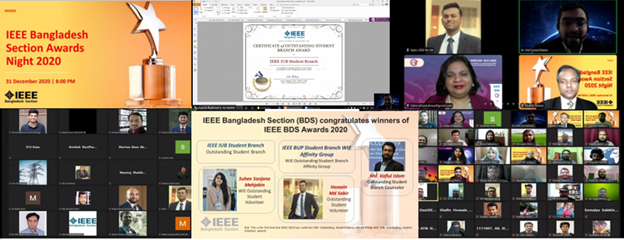
IEEE Bangladesh Section Awards Night 2020
Md. Zunaid Baten, Awards Coordinator for IEEE Bangladesh Section
On 31st December, 2020 IEEE Bangladesh Section hosted a virtual Awards Night. Prof. Dr. Celia Shahnaz, IEEE Bangladesh Section Chair presided over the program. Prof. Dr. Zunaid Baten, Awards Coordinator, IEEE Bangladesh Section moderated the Awards Session. More than 200 members joined the program.
IEEE Bangladesh Section (BDS) is glad to announce again the winners of IEEE BDS Awards 2020 under the following categories:
Outstanding WIE Student Branch AG: IEEE BUP Student Branch WIE AG
Outstanding Student Volunteer: Hossain Md Sabir
Outstanding WIE Student Volunteer: Suhee Sanjana Mehjabin
Outstanding Student Branch Counselor: Md. Kafiul Islam
Honorable Mentions:
Outstanding WIE Student Branch AG: IEEE BUET Student Branch WIE AG
Outstanding WIE Student Volunteer: Syed Sadia Hossain
It is to be noted that this is the first time that IEEE BDS confer WIE Outstanding Student Branch Affinity Group and WIE Outstanding Student Volunteer awards. IEEE BDS congratulates all the award winners for their outstanding contributions to IEEE Bangladesh Section 2020.
Celia Shahnaz, Chair for IEEE Bangladesh Section S M Saiduzzaman, Newsletter Editor for IEEE Bangladesh Section
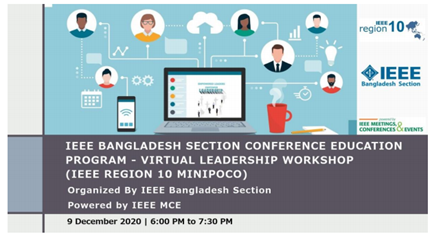
Under an approved fund for R10 Mini POCO, IEEE Bangladesh Section organized 2 workshops by IEEE MCE for training on conference organization. The workshops were held on 2nd and 9th December, 2020. The workshops were funded by IEEE Region 10. The resource person for both events was Fred Schindler, FIEEE from IEEE Conference Committee.
The first workshop on 2nd December, 2020 was conducted for the Section Leadership for their further perusal so that they can evaluate the conference applications for technical sponsorship or co-sponsorship. The pros and cons of a conference emphasizing the evaluation and maintenance of technical quality throughout the conference and its addition to the Xplore repository were elaborately discussed by Fred Schindler. All the 15 ExCom Members of IEEE Bangladesh Section including Past Chair Prof. Shaikh Fattah attended the workshop. John Tracy moderated the session with a short introduction speech from Dr. Celia Shahnaz, Chair for IEEE Bangladesh Section.
The second workshop was held on 9th December, 2020 for the conference organizers and Section members. This workshop emphasized on ensuring and maintaining the technical quality in various steps of a conference. Furthermore, some confusions and questions were cleared during the interactive QA Session by the resource person Fred Schindler. Dr. SN Singh, Vice Chair, IEEE R10 Technical Activities; Dr. Michael Ong, Conference and Technical Seminar Coordinator, IEEE Region 10 and Dr. Celia Shahnaz, Chair, IEEE Bangladesh Section were other panelists of the session with John Tracy as the moderator. Around 50 people attended the workshop including various conference organizers of Bangladesh.
Dr. Celia concluded the session by giving a vote of thanks to all the attendees and the panelists. She encouraged the workshop attendees to implement the key points from the workshop in their conferences and welcomed everybody to contact her in case of any confusion.
Bengalis Research Forum 2021
Celia Shahnaz, Chair for IEEE Bangladesh Section S M Saiduzzaman, Newsletter Editor for IEEE Bangladesh Section
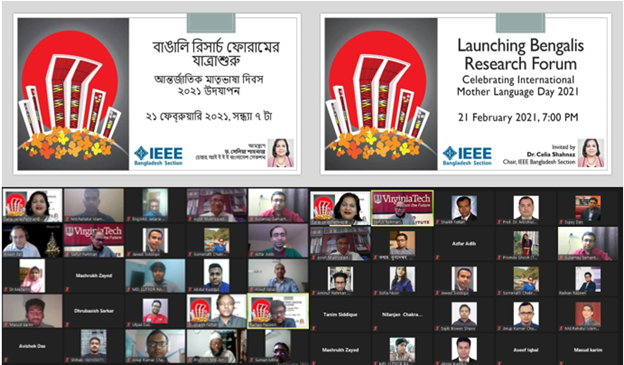
21st February is observed worldwide as the International Mother Language Day commemorating the martyrs of the mother language movement on 21st February, 1952 in the then East Pakistan, present Bangladesh. To pay respect to the sacrifices of the language martyrs and as an initiative of the Reaching Locals Project, IEEE Bangladesh Section organized the 1st Bengalis Research Forum on 21st February, 2021. The theme was to gather the Bengali (Bangla) speaking research scholars and enthusiasts focusing on the mass enactment of local language Bangla based educational and research activities in the field of Electrical, Electronic, and Computer Engineering. More than 100 Bengali-speaking distinguished scholars and enthusiasts from the USA, Japan, India, Australia, UK, Germany, and Bangladesh attended the event. They candidly discussed the challenges and proposed solutions and opportunities to encourage the Bengali instruction medium based research activities among Bengali-speaking individuals worldwide. The forum unanimously emphasized that there is no alternative to Bangla medium based scientific and technological practice through different endeavors i.e. research article and book publication, technical communication, translating key technical books into local languages, and so on in order to increase and uphold the thousand years’ glory of Bengali Language. The attendees also thanked the organizers for the forum initiative and expressed the importance of frequent organization of such activities from a technical institute like IEEE to reach out to the locals. The program was moderated and chaired by Prof. Dr. Celia Shahnaz, Chair for IEEE Bangladesh Section. The full program was conducted in Bangla.
R10 EAC Funded “Bridge the Healthcare Gap: Introducing Telemedicine and IoT to Secondary Schools Students”
Raihan ur Rashid, Secretary for IEEE Bangladesh Section
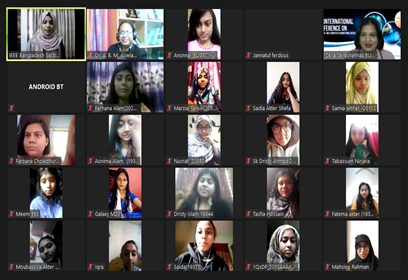
IEEE Bangladesh Section organized a virtual workshop titled “Bridge the Healthcare Gap: Introducing Telemedicine and IoT to Secondary Schools Students” on 20th December, 2020 aiming to promote engineering education to pre-university students. 100 students of class 11 and 12 from Engineering University Girls School and College, Dhaka, Bangladesh have actively participated in the program.
Prof Dr. Celia Shanaz, Chair for IEEE Bangladesh Section was the Chief Guest of the program. In her speech, the honorable chief guest focused on the importance of IEEE and its educational activities as well as the necessity and impact of engineering education in national development. Jannatul Adan, Humanitarian Activities Coordinator for IEEE Women in Engineering Affinity Group (WIE) Bangladesh Section was the anchor for the program.
Prof. Dr. A. B. M. Aowlad Hossain, Educational Activity Coordinator of IEEE Bangladesh Section was the resource person to conduct the workshop. Firstly, Prof. Hossain gave a presentation on the overview of IEEE and its educational activities as well as the necessity of such program. The available online resources of IEEE for pre-university education like TryEngineering, TryComputing, TryNano have been introduced to the participants even with native Bengali language. Then, he started the main topic on telemedicine and its benefits to improve healthcare.
RADIOGENOMICS AND DEEP LEARNING IN MANAGEMENT OF BRAIN CANCER
Sushmita Mitra, Professor, Machine Intelligence Unit, Indian Statistical Institute, Kolkata, FIEEE
Radiomics (or quantitative imaging) constitutes the high-throughput automated (or semiautomated) extraction of large amounts of quantifiable information (or image features) from radiographic images for improved management of the disease (or tumor) [1]. It requires the mining of large image datasets, to reflect and quantify the inherent heterogeneities, for improved decision-making. Radiomic features provide richer information about intensity, shape, size or volume, and texture phenotype, and are complementary to that provided by clinical reports, laboratory test results, and genomic or proteomic assays [2]. Feature selection aims at dimensionality reduction, in order to lower the computational cost of classification while not hampering the discriminatory power of the system. Computer-based medical image analysis is thus becoming an important field; mainly because of the high rate of production of images, as well as the increasing reliance on these by the biomedical community. Today radiographic imaging modalities, like computed tomography (CT), positron emission tomography (PET) and magnetic resonance imaging (MRI), are playing a major role in the diagnosis and prognosis of cancer.
Cancer is a disease of genetic instability, often associated with genes directly involved with cell growth and proliferation, differentiation, survival and apoptosis, or indirectly involved through genes participating in cell signal transduction pathways. Current development in genomics and proteomics has enabled molecular profiling of biological specimens by simultaneously revealing the expression levels of thousands of genes and proteins. Gene expression patterns of cancer tissues can reveal its etiology, prognosis and response to therapy, and facilitate individualized selection of therapies. Here feature selection helps in filtering out and focusing on those sets of differentially expressed genes, from the diseased tissue, that can be best correlated with patient prognosis and clinical outcome [3].
It has become increasingly clear that patient-specific gene mutations and certain tumor characteristics result in each patient having her own disease, which again warrants specific treatments. The concept of using advanced diagnostic capabilities to tailor treatment, specific to an individual’s genetic build, is called personalized (or precision) medicine [1]. This aims to individualize treatment towards the specific characteristics of a patient and her tumor genotype. Associating molecular genotypes with imaging phenotypes (biomarkers) is termed radiogenomics, and it throws up an exciting emerging field of research. It holds promise for personalized optimal treatment [4], while eliminating the hazards of over-diagnosis. Characteristic features from the segmented region of interest in an image can be correlated with the gene expression profile of the tumor to determine its non-invasive imaging surrogates (or substitutes) [5].
With the worldwide availability of “big” datasets in healthcare (encompassing images and patterns in digital form), high computing power, efficient low-cost algorithms, and easy access to cloud computing solutions, the growth of interest in artificial intelligence (AI) applications is increasing. The automated mining of radiomic information from images (typically not discernible visually) is enhancing the diagnostic and prognostic benefits of patients, as derivable from images. Learning can be supervised (with class labels) or unsupervised (clustering/ segmentation), through maximizing (minimizing) patient similarity within (between) clusters. Attributes like age, gender, disease history, diagnostic imaging, gene expression, electrophysiological tests, physical examination results, clinical symptoms, medication, can serve as input to the learning algorithm. The output (knowledge) can consist of disease indicators, patient survival time, and quantitative disease measures (like tumor size or grade).
Objects of interest in medical images, in the context of cancer, would correspond to lesions and tumors. These again are of various shapes and inhomogeneity, even including spiculation at the surface. Such volumes of interest often become too complex to be accurately represented by any simple equation and/or model. It requires a complex model with a large number of parameters that cannot be accomplished manually and becomes data dependent. This is where the role of machine learning becomes important in medical imaging, through mining tasks like feature extraction (like, contrast, area, circularity), feature selection, clustering or segmentation, and classification (like, cancerous or benign, grading, etc.). The role of machine learning is to determine an optimal discrimination between the multiple output classes, through training, in the multi-dimensional feature space; to subsequently classify an unknown test image. Some of the popular learning algorithms include linear regression, logistic regression, naive Bayes, decision trees, nearest neighbors (NN), random forests, discriminant analysis, support vector machines (SVMs), and artificial neural networks (ANNs). However, some of the sensitive issues of concern include basic pattern recognition concepts like feature selection and dimensionality reduction, through generalization over independent test sets or cross validation, while preserving repeatability and reproducibility across observations collected in multi-institutional frameworks.
Deep learning is a kind of representation learning, where a machine learns from raw data to automatically discover the representations needed for detection or classification [6]. It involves multiple levels (depth) of representation, obtained by composing simple non-linear modules, that each transform the representation at one level into another at a higher, slightly more abstract level. Deep learning, in the context of medical images, directly uses pixel values of the images (instead of extracted or selected features) at the input, without involving object segmentation; thereby, overcoming the manual errors caused by inaccurate segmentation and/or subsequent feature extraction. However, some of the inherent limitations of deep learning include high computational cost and requirement of large number of training images. Convolutional neural networks (CNNs) constitute one of the popular models of deep learning. The breakthrough in CNNs came with the ImageNet competition in 2012 [7], where the error rate was almost halved for object recognition. CNNs were revolutionally revived through the efficient use of Graphics Processing Units (GPUs), Rectified Linear Units (ReLUs), dropout regularization and data augmentation. Given that images are naturally complex and high volume, the use of deep learning has been reported mostly in imaging analysis. Some of the commonly used deep learning models in medical applications include CNNs, recurrent neural networks (RNNs), Residual convolutional neural networks (ResNets), and deep belief networks. Recently significant research was undertaken in the application of deep learning for quantitative medical imaging [8] and genomics [9].
Gliomas constitute 70% of malignant primary brain tumors in adults [10] and are usually classified as High-Grade Gliomas (HGG) and Low-Grade Gliomas (LGG) – with the latter being less aggressive and infiltrative than the former. Magnetic Resonance Imaging (MRI) has been extensively employed in diagnosing brain and nervous system abnormalities, over the last few decades, due to its improved soft tissue contrast. The MR sequences include T1-weighted, T2-weighted, T1-weighted with gadolinium-based contrast enhanced (T1C), and T2-weighed with fluid-attenuated inversion recovery (T2-FLAIR ). The rationale behind using these four sequences lies in the fact that different tumor regions may be visible in different sequences, thereby allowing a more accurate composite demarcation of the tumor involving improved tissue discrimination. For example, T1C enhances the tumor region that is well-perfused with high tumor cell density where there is a breakdown of the blood-brain barrier. This can, thereby, provide delineation of gross tumor margins and allow earlier detection of additional small metastatic lesions. Necrosis and solid tumors can also be visually distinguished. Typically, T1Cweighted images are used for monitoring tumor response to therapy. The T2-weighted sequences are sensitive to water tissue content and can be used to estimate cellular density and presence of edema. T2-FLAIR- and T2-weighted images, in conjunction, help provide a better distinction between edema and solid tumor. Accurate delineation of tumor region in MRI sequences is of great importance since it allows:
i) volumetric measurement of the tumor, ii) monitoring of tumor growth in a patient between multiple MRI scans, and iii) treatment planning with follow-up evaluation.
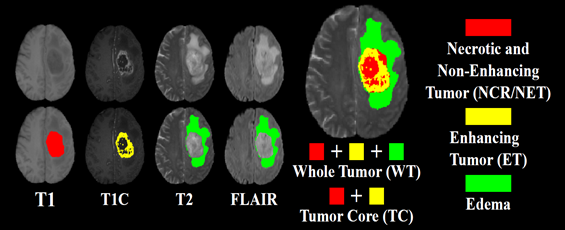
Fig. 1: Segmentation view of glioma sub-regions in multi-modal MRI [11]
Besides detection, localization, and classification, the most widely studied aspect in medical imaging applications has been segmentation. Tumor segmentation from brain MRI sequences is usually done manually by the radiologist. Being a highly tedious, time-consuming and error-prone task, mainly due to factors such as human fatigue, overabundance of MRI slices per patient, interobserver variability, and increasing number of patients, such manual operations often lead to inaccurate delineation; thereby potentially leading to unstable results in the radiomic analysis.
The need for an automated or semi-automated Computer Aided Diagnosis thus becomes apparent. It can also serve to improve the accuracy in automatic detection in order to assist doctors in diagnosing faster and on time. The segmentation of the glioma and its sub-regions, in multi-modal MRI, is depicted in Figure 1.
REFERENCES
S. Mitra and B. Uma Shankar, “Integrating radio imaging with gene expressions towards a personalized management of cancer,” IEEE Transactions on Human- Machine Systems, vol. 44, pp. 664–677, 2014.
M.Avanzo, J. Stancanello, and I. El Naqa, “Beyond imaging: The promise of radiomics,” Physica Medica, vol. 38, pp. 122–139, 2017.
T. R. Golub, D. K. Slonim, P. Tamayo, and et al., “Molecular classification of cancer: Class discovery and class prediction by gene expression monitoring,” Science, vol. 286, pp. 531–537, 1999.
E. Segal and et al., “Decoding global gene expression programs in liver cancer by non-invasive imaging,” Nature Biotechnology, vol. 25, pp. 675–680, 2007.
C. Jaffe, “Imaging and genomics: Is there a synergy?” Radiology, vol. 264, pp. 329–331, 2012.
Y.LeCun, Y. Bengio, and G. Hinton, “Deep learning,” Nature, vol. 521, pp. 436–444, 2015.
A. Krizhevsky, I. Sutskever, and G. Hinton, “ImageNet classification with deep convolutional networks,” in Advances in Neural Processing Systems, vol. 25, pp. 1097–1105, 2012.
D. Shen, G. Wu, and H. I. Suk, “Deep learning in medical image analysis,” Annu. Rev. Biomed. Eng., vol. 21, pp. 221–248, 2017.
H. Zeng, M. D. Edwards, G. Liu, and D. K. Gifford, “Convolutional neural network architectures for predicting DNA–protein binding,” Bioinformatics, vol. 32, pp. i121–i127, 2016.
S. Bauer, R. Wiest, L. P. Nolte, and M. Reyes, “A survey of MRI-based medical image analysis for brain tumor studies,” Physics in Medicine and Biology, vol. 58, pp. R97–R129, 2013.
S. Banerjee and S. Mitra, “Novel volumetric sub-region segmentation in brain tumors,” Frontiers in Computational Neuroscience, vol. 14, p. doi: 10.3389/fncom.2020.00003, 2020.
Biography
Sushmita Mitra is a full professor at the Machine Intelligence Unit (MIU), Indian Statistical Institute, Kolkata. From 1992 to 1994 she was in the RWTH, Aachen, Germany as a DAAD Fellow. She was a Visiting Professor in the Computer Science Departments of the University of Alberta, Edmonton, Canada; Meiji University, Japan; and Aalborg University Esbjerg, Denmark. Dr. Mitra received the National Talent Search Scholarship (1978-1983) from NCERT, India, the University Gold Medal in 1988, the IEEE TNN Outstanding Paper Award in 1994 for her pioneering work in neuro-fuzzy computing, the CIMPA-INRIA-UNESCO Fellowship in 1996, and Fulbright-Nehru Senior Research Fellowship in 2018-2020. She was the INAE Chair Professor during 2018-2020. Dr. Mitra has been awarded the prestigious J. C. Bose National Fellowship, 2021.
Dr. Mitra is a Fellow of the IEEE, Indian National Science Academy (INSA), International Association for Pattern Recognition (IAPR), and Fellow of the Indian National Academy of Engineering (INAE) and The National Academy of Sciences, India (NASI). She is an IEEE CIS Distinguished Lecturer, Member of Inter-Academy Panel for Women in STEMM, and the current Chair, IEEE Kolkata Section.